EPA · WLTP · NEDC · CLTC

Convert EV range between every rating standard.

Spec sheets quote different numbers in different regions. Enter one range value and instantly see what the same car scores on EPA, WLTP, NEDC and CLTC.

Unit:
Built for clarity

One number in. Four honest answers out.

No accounts, no ads in the way, no waiting. The converter runs entirely in your browser so results update the instant you type.

Instant four-way conversion

Type once and read EPA, WLTP, NEDC and CLTC side by side. The standard you entered stays highlighted as your reference.

📏

Kilometres or miles

Switch units with a tap. Helpful when a European spec sheet meets a US buyer who thinks in miles.

🎯

Realistic by design

Conversion ratios are drawn from average gaps across many production EVs, so you compare cars on equal footing.

What is this

The four EV range standards, explained

Every region tests range differently. The same battery can earn wildly different numbers depending on the cycle, the temperature and the correction factor applied. Here's how they compare.

EPA most realistic

United States

Combines city and highway cycles, then applies a conservative correction (around 0.7) to mirror everyday driving. Usually the lowest — and closest to what you'll actually see.

EPA ≈ WLTP ÷ 1.13

WLTP global

Europe & worldwide

A four-phase, 30-minute cycle at 23°C covering city to highway speeds. More realistic than NEDC, but still optimistic versus real roads and cold weather.

WLTP = NEDC × 0.85

NEDC legacy

Old Europe

A 1970s low-speed lab cycle, retired in Europe but still quoted in some markets. Numbers run high and rarely reflect modern driving.

NEDC = WLTP ÷ 0.85

CLTC optimistic

China

Tuned to local urban driving with little high-speed running, so figures sit highest of all. Common on cars sold in China.
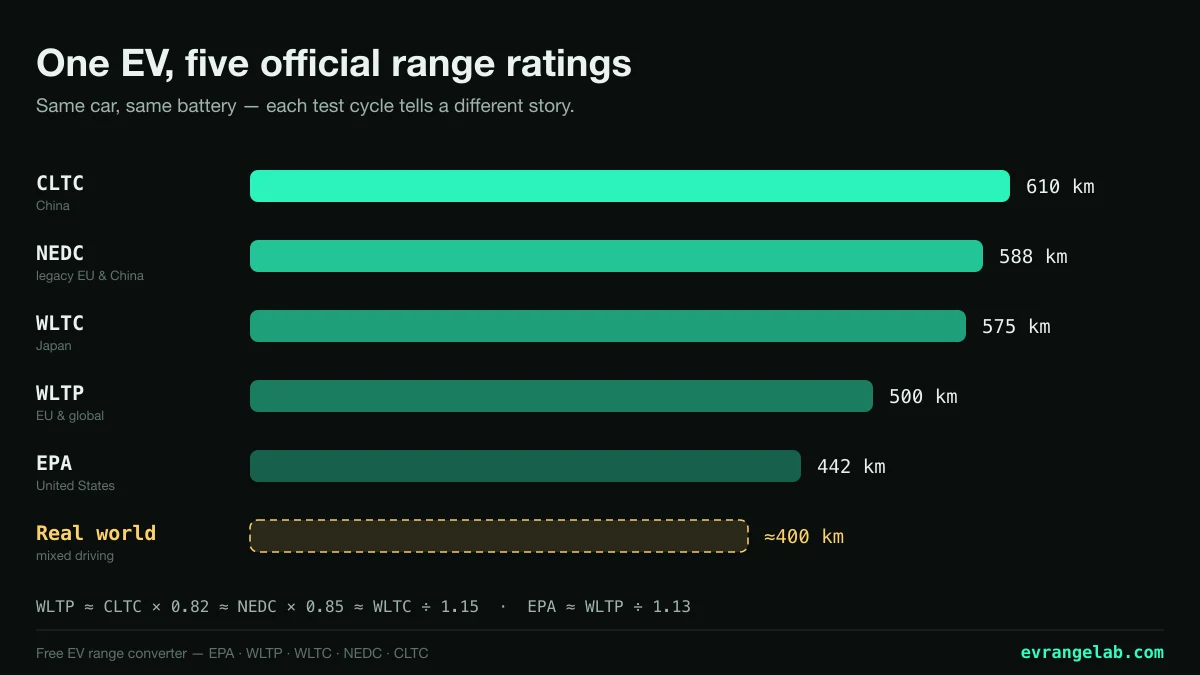
CLTC = WLTP ÷ 0.82
How to use it

Convert a range figure in three steps

01

Enter the range from the spec sheet

Type the number exactly as listed — for example, a 500 km WLTP rating or a 300 mile EPA rating.

02

Pick which standard that number uses

Select WLTP, EPA, NEDC or CLTC so the tool knows your starting point. Set the unit to km or miles.

03

Read the converted figures

All four standards update at once. Use the EPA value as your most grounded estimate of real-world range.

Why it matters

Compare EVs on a level playing field

An imported car rated 600 km CLTC isn't a longer-range car than a 480 km WLTP rival — it's often the very same range, measured differently. Converting makes that obvious.

  • Cut through marketing. A bigger headline number usually means a softer test, not a better battery.
  • Shop across borders. Comparing a US, EU and China spec becomes a fair, apples-to-apples decision.
  • Set honest expectations. The EPA-equivalent figure is your best guide to daily driving range.
  • Plan the long trips. Knowing the realistic floor matters more than the brochure ceiling.
From the blog

Understand the standards

Short, practical explainers on how EV range ratings differ and how to read them.

Questions

Frequently asked

Why is WLTP range higher than EPA range? +
WLTP runs a milder 23°C lab cycle and doesn't apply a heavy real-world correction, while the EPA deliberately discounts its result (often by around 30%) to better match everyday driving. For the same car, WLTP typically lands about 12–14% above EPA, though the exact gap varies by vehicle.
How do I convert CLTC to WLTP? +
CLTC figures are the most optimistic of the four. A widely used estimate is WLTP ≈ CLTC × 0.82, so a 600 km CLTC rating works out to roughly 492 km WLTP. Enter the CLTC number above and the tool does this for you.
Which standard should I trust most? +
EPA is generally closest to real-world results, with WLTP a reasonable second. NEDC and CLTC tend to overstate range, so treat them as ceilings rather than expectations.
Are these conversions exact? +
No — they're statistical estimates based on average ratios across many vehicles. Your real range still depends on temperature, speed, terrain, payload and driving style. Use the numbers for comparison, not as a guarantee.
Does the converter store my data? +
Nothing is sent anywhere. The math runs entirely in your browser, so whatever you type stays on your device.